


CEE AI Index is the first index focused on assessing the ability of Central and EasternEuropean countries to develop, operate, and host AI efficiently, safely, and in agoverned way.
Evaluated across 33 indicators and 363 data points, the CEE AI Index delivers a deeper insight about region that is at a critical structural crossroads, splitting cleanly into two trajectories: the shapers (nations structurally prepared to lead and anchor European AI) and the consumers (nations still struggling to lay foundational infrastructure).
The index was built to give policymakers, investors and ecosystem builders a factual basis for understanding where the region stands – and where it needs to move. "Central and Eastern Europe has been building the conditions that serious AI investment requires: governance frameworks, talent pipelines, and in several markets, infrastructure that is already operational," says Tomasz Snażyk, CEO of the AI Chamber.
"What has been missing is the data to make that case with precision. For anyone allocating AI capacity in Europe over the next few years, the picture this index paints is one that is hard to ignore and early enough to act on."
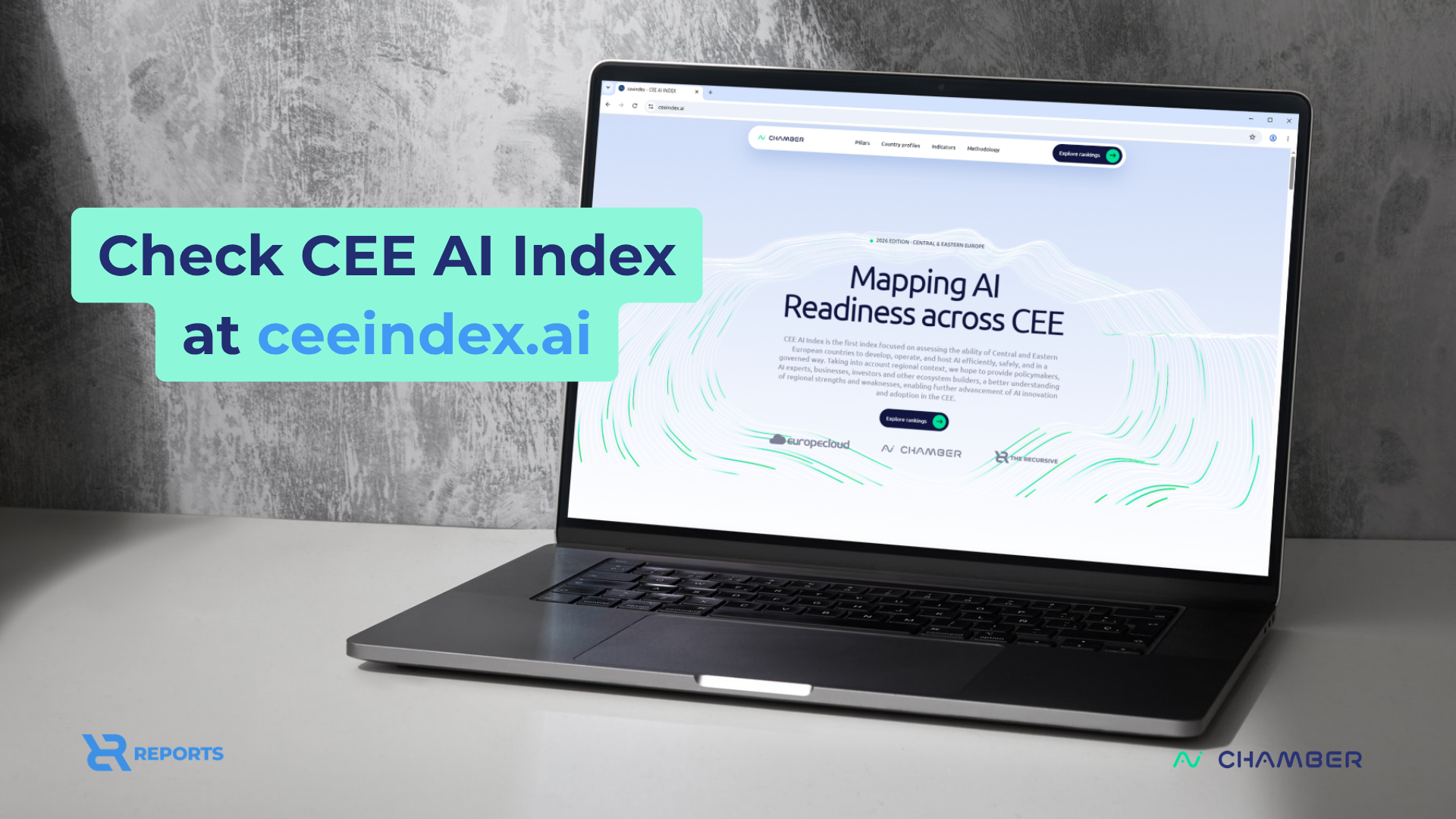
The core philosophy: Strategic AI Readiness
Discarding global benchmarks that are skewed by the massive market outliers of the US and China, the CEE AI Index 2026 evaluates the Central and Eastern European region on its own terms. Rather than measuring the capacity to compete with global tech giants, the index looks at strategic AI readiness: the structural capacity to safely, efficiently, and securely host and operate an AI ecosystem.
It evaluates performance across three foundational pillars:
- Environment: Governance frameworks, regulatory coordination, policy continuity, and infrastructure.
- Resources: Talent density, and the capital activity.
- Deployment: Enterprise AI adoption rates and academic/scientific research outputs.
Furthermore, in 2026, simply using AI is no longer the benchmark for progress. This Index introduces indicators designed to capture a nation's readiness to transition toward high-performance, sovereign, and aligned AI.
CEE AI Index 2026 Leaderboard highlights
CEE is splitting into countries that will shape AI in Europe and countries that will consume it. The difference isn't size, but sovereignty, governance readiness, talent investment and institutional ambition across the region.
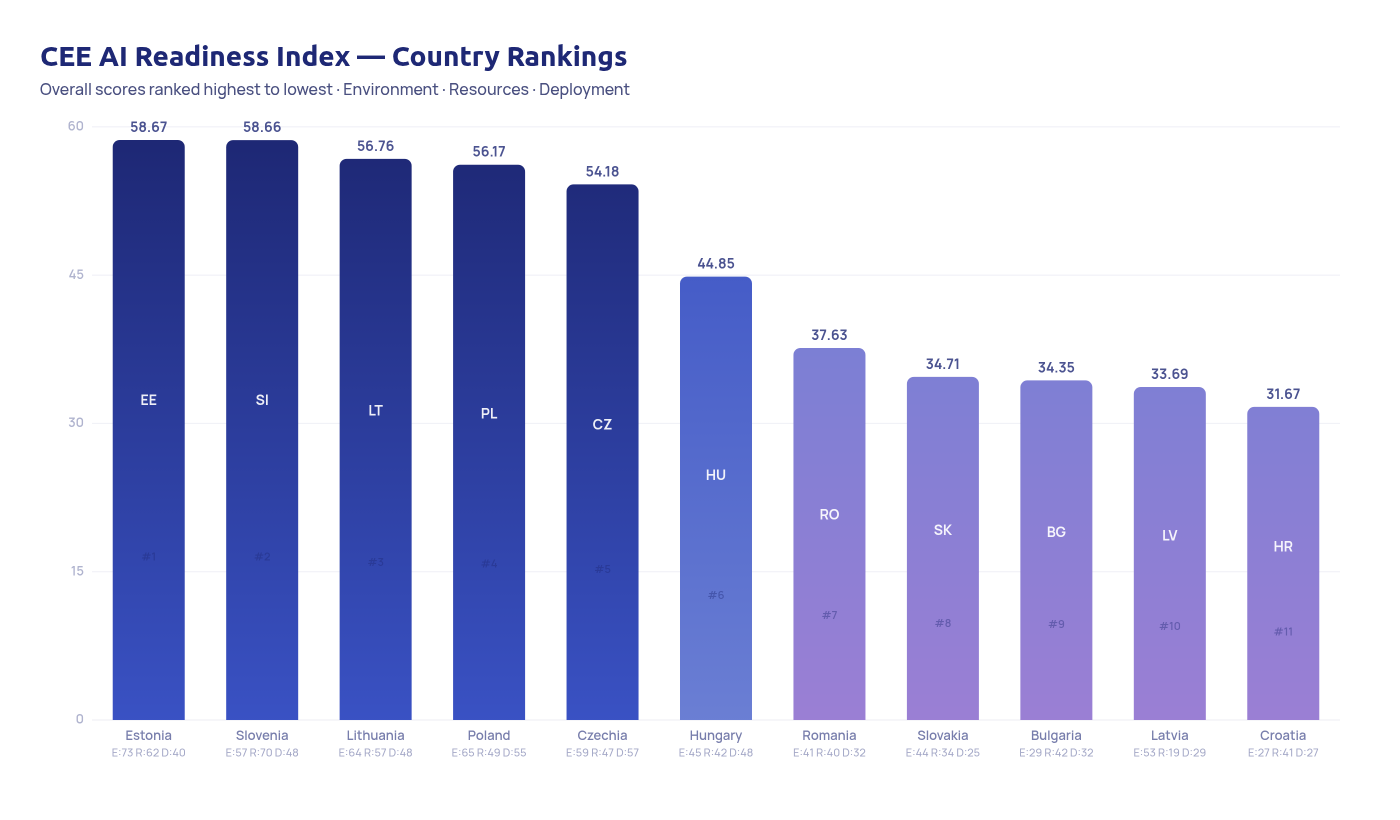
Here is the overview of top 5 placements:
Estonia (1st Place): The regional pioneer. Estonia leads the Environment pillar with an impressive score of 73 points, driven by its world-renowned digital ecosystem, institutional maturity, and cohesive AI frameworks.
Slovenia (2nd Place): A powerhouse for deep tech and academia, Slovenia stands out heavily for its immense research intensity and robust STEM pipeline capacity.
Lithuania (3rd Place): Punches well above its weight, scoring high in Environment (64 points) due to exceptional open data governance and an aggressive market demand for AI professionals.
Poland (4th Place): The undisputed heavyweight market of the region. Poland ranks 2nd in the Environment pillar (65 points) and anchors the CEE in raw scale; boasting the region’s largest AI workforce, the highest volume of scientific research output, and the greatest high-performance computing (HPC) capacity.
Czech Republic (5th Place): A commercial leader that co-leads alongside Poland in the Deployment pillar, showing exceptionally deep enterprise adoption and commercial integration of AI tools.
Other Regional Progress: Hungary, Romania, Slovakia, Bulgaria, Latvia and Croatia are successfully building highly localized competitive advantages, ranging from specialized tax incentives and experimentation sandboxes to niche technical expertise and education programs.
Key regional findings of the CEE AI Index 2026
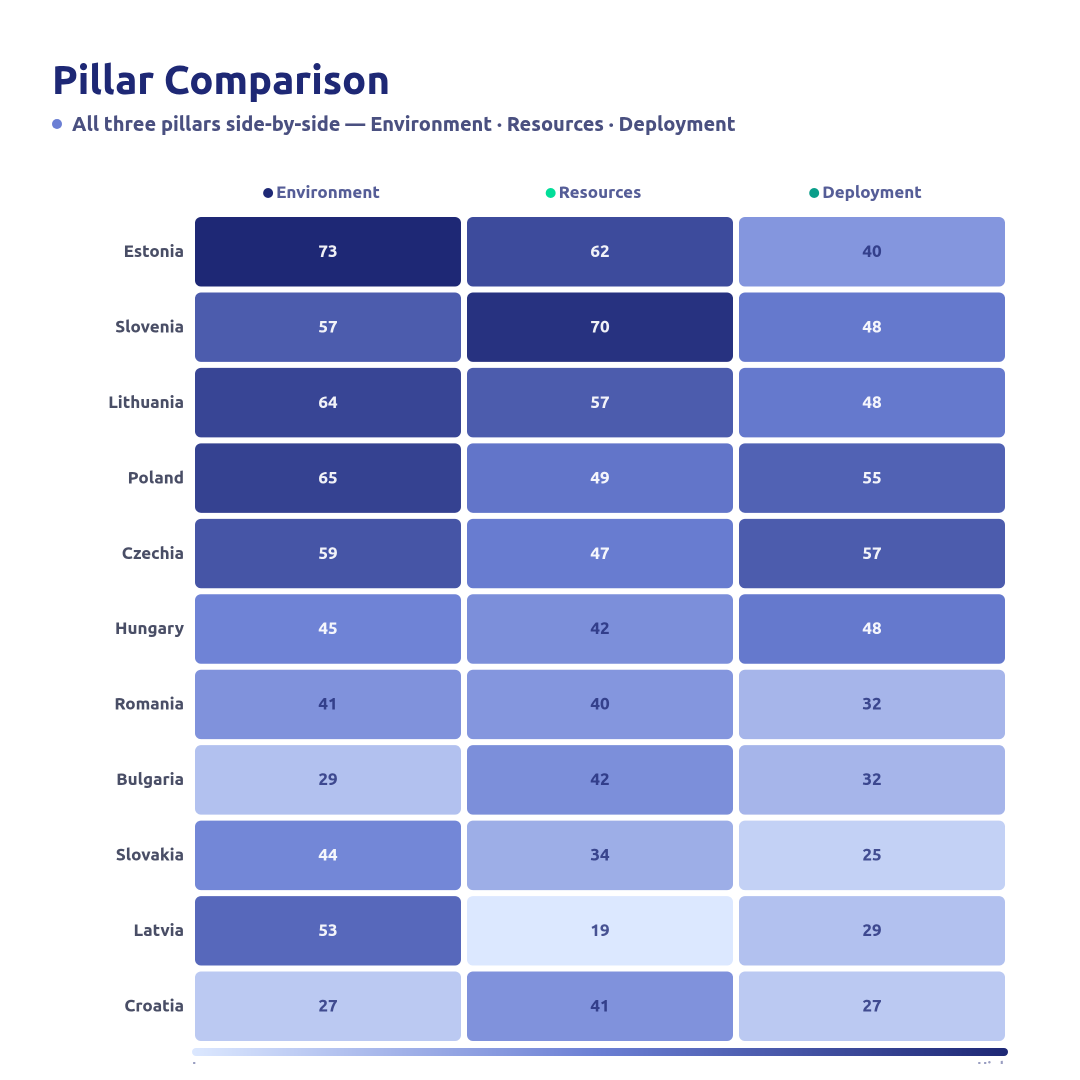
CEE is one region, but not one story. What the index reveals is a distributed set of strengths that, taken together, make a compelling case for the region as a whole. For that matter, here are key insights from the overall Index findings:
Governance is the ultimate differentiator. While almost all evaluated CEE nations have drafted official national AI strategies, the index proves that a policy on paper does not equal operational readiness. Countries that have built mature institutional capacity and regulatory clarity are successfully converting those frameworks into enterprise trust, making them much more attractive to investors.
Agility over scale. Economic or geographical size does not dictate AI success in the region. Several smaller nations are heavily outperforming larger economies by executing highly targeted investments in data governance, specialized talent, and digital infrastructure.
The emerging regional divide. A distinct structural gap is forming between the top tier (nations structurally prepared to help shape Europe’s broader AI landscape) and lower-tier countries that are still gridlocked in constructing foundational prerequisites.
Complementary patchwork strengths. Rather than aggressively competing against one another, CEE nations present a matrix of highly compatible ecosystem strengths. While one country provides raw market scale and workforce volume, another provides peerless open-data structures or research intensity.
The global representation deficit. A major editorial takeaway from the findings is a disconnect in global visibility. Despite boasting highly advanced digital governance, operational infrastructure, and a deep pool of technical experts, the CEE region remains vastly underrepresented in major global AI investment and development dialogues.

CEE AI Index
AI Chamber, in partnership with The Recursive Media and collaboration of Europe Cloud, has launched the CEE AI Index 2026, the first index focused on assessing the ability of Central and Eastern European countries to develop, operate, and host AI efficiently, safely, and in a governed way.
Check the rankings!The AI Act as a Wedge
The upcoming enforcement of the EU AI Act is set to widen the regional divide.
Countries with pre-existing, mature institutional governance (Estonia, Poland, Czechia) are in a prime position to flip regulatory compliance into a competitive advantage, converting strict rules into enterprise trust to attract risk-averse institutional investors.
Conversely, countries still building core governance frameworks will face a grueling double-whammy: trying to accelerate domestic innovation while suffocating under complex European compliance frameworks.
What the index means for the region
The CEE AI Index 2026 arrives at a moment when AI sovereignty is no longer an abstract concept. For investors and policymakers, the Index offers a granular map of where AI readiness in Europe is already operational - and where it remains aspirational.
"Central and Eastern Europe is home to some of Europe's strongest AI talent, yet a significant investment gap with the rest of the continent persists – in both public and private funding", points Mark Boris Andrijanič, former Minister for Digital Transformation of Slovenia and former lead EU Council negotiator on the DMA and DSA.
"Estonia, Lithuania, and Slovenia lead the CEE AI Index, outperforming countries many times their size in digital governance, talent, and infrastructure. Yet despite this rapid rise, the region has only recently begun to feature in the conversations where Europe's major AI investment decisions are made. This index brings both the arguments and the urgency those conversations have been missing."


Member discussion