


Founders spend a lot of time thinking about the external factors that determine whether their companies succeed: finding the right investors, hiring the right people, reaching product-market fit, entering the right market. And, inevitably, being in the right place at the right time.
But how much of success is really luck? And how much of that luck can we create ourselves?
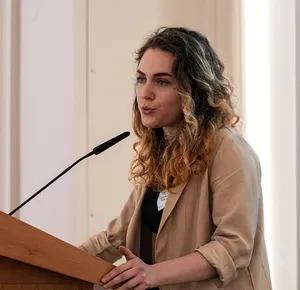
We met with behavioral design expert and bestselling author Nir Eyal on an August morning in Prague, where he is spending part of his summer holiday before taking the stage at The Mindset Advantage by Impact Nights in the city this Thursday. We sit down to discuss his new book, Beyond Belief, and an idea that quickly brings the conversation back to entrepreneurship, what Eyal calls “provoked luck.”
Founders cannot control everything that happens to them. What they can influence, Eyal argues, are the beliefs that determine whether they keep putting themselves in situations where something might happen in the first place.
For founders, those beliefs can be remarkably practical. I can figure this out. I can learn what I don't know. I can try again if this doesn't work. Or, on the other side: I don't have the right connections. I didn't go to the right university. Startups from my market don't get funded.
This is at the heart of Beyond Belief, the idea that we often treat our assumptions about ourselves and the world as facts, without realizing how much they shape what we notice and how we act.
"The number one determining trait of whether an entrepreneur will succeed or fail is not intelligence. It's not skill. Skill can be learned. It's persistence," Eyal says. "Persistence doesn't guarantee success. But quitting guarantees failure."
Beliefs are not facts
"Are we born as founders? No. It's a skill like any other," Eyal tells me. And this distinction becomes particularly important for entrepreneurs. As he argues, founders can easily take something that is true today: I'm not good at fundraising, I don't have the right network, I've never built a company before; and turn it into a conclusion about what they are capable of becoming.
That creates room for a subtle shift in language. Telling yourself I'm the best entrepreneur who ever lived is difficult to reconcile with evidence. But I'm learning to become a better entrepreneur leaves space for both the reality of where you are today and the possibility of improvement tomorrow.
It also gets at a broader point Eyal makes throughout our conversation: useful beliefs aren't the same as wishful thinking.
The goal isn't to convince yourself that your startup will succeed regardless of the evidence. It's to recognize which conclusions are facts and which are stories about what might happen next.
For Eyal, useful beliefs therefore don't have to predict the future perfectly. They need to remain grounded in evidence while helping people take productive action.
How founders can collect evidence
Eyal elaborates that beliefs change when people encounter new evidence, and that evidence can come from deliberately paying attention to information they previously ignored.
"I worked with a woman who believed she was terrible at public speaking, and she would go to pitch in front of investors. ‘It’s not for me. I’m very bad at public speaking. I get very nervous.’ Well, is that a fact or is that a belief?"
The result was a feedback loop: she remembered the failures, those memories reinforced her belief that she was a poor speaker, and that belief reduced her motivation to practice. Eyal suggested that she record her presentations and keep what he calls a “reality log,” documenting not only her mistakes but also the moments when she performed well.
"If I believe I'm no good at public speaking, how likely am I to practice and try? Not very. Replace that with the belief that I'm improving my public speaking through practice, and the incentive to keep practicing changes."
This is also where co-founders, mentors and investors can play a role. Rather than simply offering encouragement, Eyal suggests they can point to concrete evidence of improvement: what worked, what changed, and what should be repeated.
The goal isn't to eliminate ambitious beliefs
Startup culture is hardly suffering from a shortage of ambitious claims. Founders are expected to explain how their companies could become billion-dollar businesses and dominate markets. For Eyal, however, even seemingly unrealistic beliefs can be useful, as long as they don’t contradict the facts and encourage action.
He recalls meeting a woman in her early twenties who told him she dreamed of winning the Nobel Peace Prize but was embarrassed by how unrealistic the ambition sounded.
"‘Is it against the laws of physics that you can't win the Nobel Peace Prize? Is it absolutely impossible?’ I asked her. Even if there were only a 1% chance, maybe a 0.1% chance, the possibility still existed."
More importantly, Eyal challenged her to consider what acting according to that belief might lead her to do. "Let's say you don't win the Nobel Peace Prize, but you still act as if you are going to win the Nobel Peace Prize. What's the worst-case scenario? You helped millions of people and you didn't get the medal."
The same logic can apply to founders. "You have to work on something that, even if it fails financially, was still worth doing," Eyal says. That might mean building a product the founder personally needs or solving a problem they understand deeply. Financial success remains uncertain, but it is no longer the only measure determining whether the years spent building the company were worthwhile.
What founders can learn from Silicon Valley's relationship with failure
Certainly, when we talk about failure in entrepreneurship, we cannot ignore the cultural differences between Silicon Valley and much of the rest of the world: the way entrepreneurial failure is interpreted.
In Silicon Valley, Eyal argues, a founder can raise millions, fail to build a successful company, explain what they learned, and potentially raise funding again.
"If someone gives you millions of dollars and you tried your best and you lost their money — good for you. Literally, they would say, ‘You know what? You did what you were supposed to do. You worked your hardest. You tried.’"
Failure, in this interpretation, doesn't necessarily say anything definitive about whether the founder is capable of building a successful company. "You can then go and say, ‘Hey, I raised X amount of money for my last venture. It didn't work. Here's what I learned. And here's this new idea I have from what I learned.’ People will happily give you money again," Eyal says.
"In the rest of the world, that's not the case. In the rest of the world: ‘Oh, you lost millions of dollars. You're a failure.’ That's a belief. It's just a belief."
For Eyal, the problem is what happens when a failed outcome becomes a judgment about the person behind it. The company failed can gradually become I am a failed founder. And once failure is interpreted as evidence of a fixed ability rather than information from an experiment, founders have less reason to try again.
He connects this with psychologist Carol Dweck's distinction between fixed and growth mindsets. "In Europe (I think this is a broad generalization) there's more of what's called a fixed mindset," Eyal says. "People think you're either talented or you're not."
Entrepreneurship, in his view, shouldn't be treated this way.
"What's much healthier is a growth mindset. Talent isn't born. Talent is learned when it comes to these types of things. Entrepreneurship is a skill you learn like any other."
Failure isn't final verdict
Failure can therefore still produce something valuable: new evidence.
"And here's what you learned that made your original hypothesis wrong," Eyal continues.
That last condition is important. Eyal isn't arguing that every failed startup should automatically be celebrated, or that founders should ignore poor decisions. Rather, the distinction is between failure that produces learning and failure that is treated as a final verdict on someone's ability.


Member discussion