


The commercial space industry has long operated on a model of bespoke engineering. For decades, deploying a satellite meant commissioning a unique, highly specialised piece of hardware, waiting years for assembly, and paying a premium that restricted orbit to governments and massive corporations. But the economics of space are shifting rapidly.
As launch costs plummet thanks to reusable rockets, the bottleneck has moved from getting to space to actually building the hardware that operates there. Now, one CEE company is betting that the future of orbital infrastructure lies not in custom craftsmanship, but in ruthless standardisation.
A year after its previous major capital injection, Bulgarian spacetech EnduroSat has closed a $205 million (€178 million) funding round to dramatically scale its next-generation satellite fleets.
The investment, co-led by Riot Ventures and Atreides Management, brings together a heavy syndicate including the European Innovation Council, Google Ventures, Founders Fund, House Capital, Lux Capital, Omnes Capital, Giant Ventures, Emphatic Capital & Endeavor Catalyst.
This new capital is secured for a highly specific purpose: moving the company's ESPA-class FRAME satellite line into high-volume serial production, achieving a level of repeatability normally associated with consumer drones rather than orbital spacecraft.
Building satellites like drones

"EnduroSat is redefining how space infrastructure is built and deployed," explains Stephen Marcus, Co-Founder and General Partner at Riot Ventures. "Their production capabilities are aligned with the evolving demands of a new generation of satellite operators."
The core philosophy driving this shift is extreme modularity.
By utilising a software-defined, cableless architecture, EnduroSat allows a single technician to assemble and functionally test a complete satellite in just eight hours. This drastically reduces the time-to-orbit for commercial and governmental constellation operators, bypassing the traditional multi-year lead times that have historically plagued the aerospace sector.
It is a manufacturing approach that prioritises speed and reliability, ensuring that space assets can be deployed almost on demand.
‘’More frequent, lower-cost access to orbit is expanding the set of companies that can leverage space-based capabilities. We are delighted to be investing in EnduroSat, which designs, produces, and operates the satellites those companies need, at a manufacturing cadence required to meet that demand," commented Gavin Baker, Founder, Managing Partner & CIO at Atreides Management.
From 200kg to five-ton fleets
The fresh $205 million (€178 million) injection will directly fund the expansion of the company's capabilities into significantly larger spacecraft categories. While EnduroSat built its initial reputation on smaller platforms, it is now pushing aggressively into heavier payloads to meet the demands of modern constellation operators.
The FRAME product line spans multiple tiers, from the FRAME S designed for 70 kg payloads, to the FRAME L handling up to 300 kg. Now, the strategic focus shifts heavily toward the FRAME Max and beyond, targeting the production of standardised satellite fleets weighing between 200 kg, 500 kg, and even up to five tons.
These heavier, more capable platforms are critical for energy-intensive applications such as global broadband connectivity, advanced high-resolution Earth observation, and the deployment of in-orbit computing data centres.
Re-industrialising the EU and US
Central to this aggressive scaling effort is a major physical infrastructure expansion. The funding will finance the opening of a new high-volume manufacturing facility in the United States, alongside the further development of the European Union's largest space and defence hub, as it was announced this summer.
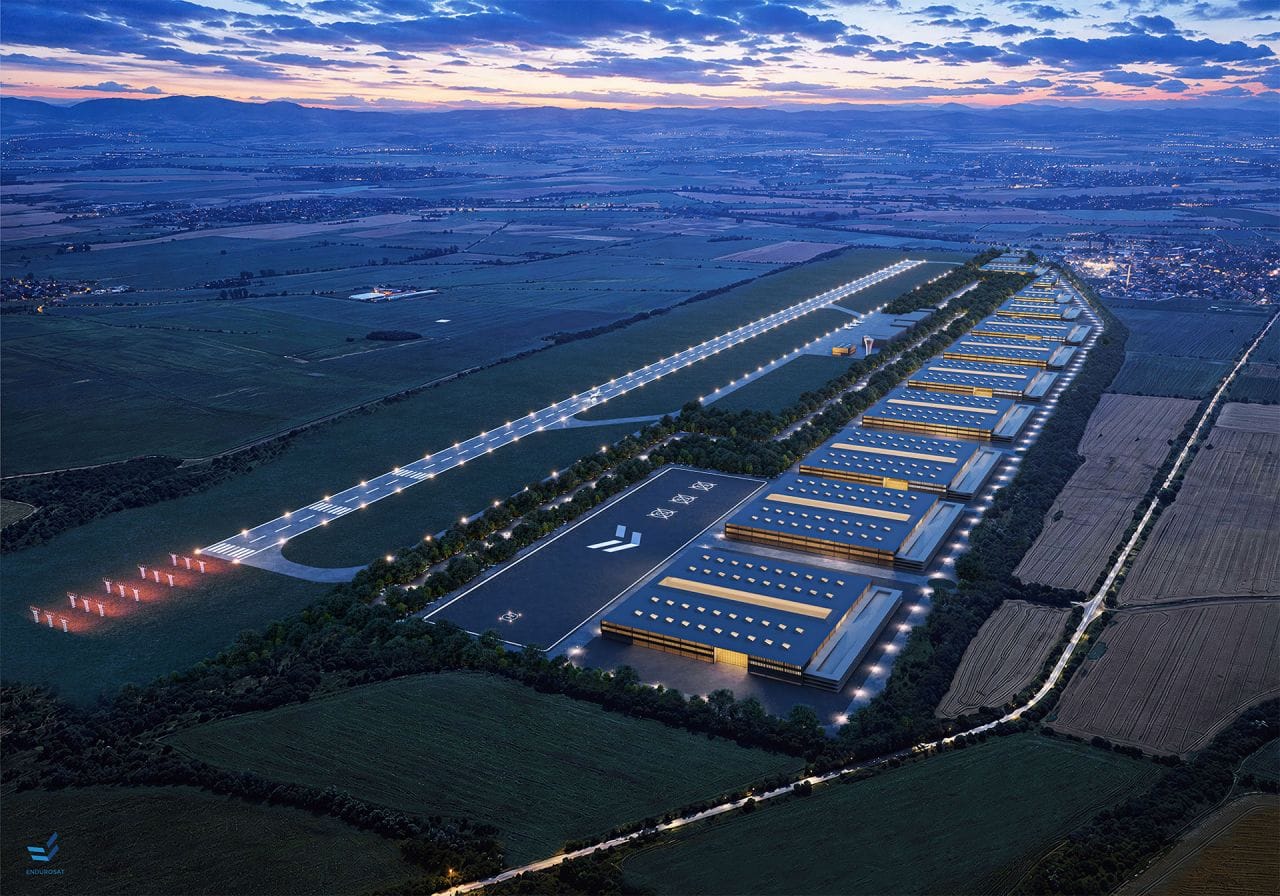
This builds upon the foundation laid late last year when EnduroSat officially inaugurated its state-of-the-art Space Center in Sofia, Bulgaria. That 188,340-square-foot facility already houses advanced RF laboratories, ISO-classified clean rooms, hardware mechanical labs, and comprehensive space qualification testing grounds.
By expanding its physical footprint across two continents, EnduroSat is positioning itself at the very centre of a broader political and economic push for the re-industrialisation of both the EU and the US aerospace supply chains.
The one dollar per gigabyte ambition
Behind the hardware expansion lies a purely economic ambition: driving the cost of space data down to roughly $1 (€0.92) per gigabyte. Currently, accessing orbital data can cost hundreds of dollars per gigabyte, a price point that effectively locks out the vast majority of small and medium enterprises.
If EnduroSat can achieve its target unit economics through drone-like mass production, it will essentially commoditise space data.
At that drastically reduced price, entirely new markets open up. Agricultural firms, logistics companies, and climate monitoring startups could afford to integrate live space data directly into their daily operations. The ultimate goal is turning space from an exclusive, capital-intensive domain into an accessible, profitable software layer for virtually any business on Earth.
Or, as Raycho Raychev, Founder & CEO of EnduroSat shared in the official announcement of the round:
‘’The vision remains untouched: democratize access to space data. Our job is to empower the innovators at the final frontier - eliminating complexity and tedious supply chains, and making their services profitable from the get-go. Now it's time to scale things up a notch. I'd like to thank Riot, Atreides and all our investors for the vote of confidence as we keep building dramatically larger-scale space infrastructure.’’
A rapid trajectory from Sofia to orbit
The sheer speed of EnduroSat's capital accumulation reflects the urgency of the new space race. Founded in 2015 by Raycho Raychev, the company has rapidly evolved from a regional deep-tech hopeful into a dominant global player.
The current round follows a highly active period of fundraising. In May 2025, the company secured a €43 million investment led by Founders Fund to scale its Gen3 ESPA-class satellites (200–500 kg). Just months later, in October 2025, it raised $104 million (€90 million) to expand initial production in Sofia.
By consistently hitting its manufacturing milestones, the Bulgarian firm has proven that Central and Eastern Europe can produce world-class, globally competitive aerospace infrastructure. The national government has even recognised the Sofia facility as a priority investment project, providing institutional backing that underscores the strategic importance of the space sector for the region's long-term technological sovereignty.
Already on track to become one of the largest satellite manufacturers in the world, EnduroSat has successfully launched 103 satellites into orbit and delivered more than 200 for missions across the globe. As the broader industry moves away from custom builds and embraces the unforgiving logic of mass production, the true measure of success will not just be how many satellites can be built in a day, but how cheaply their crucial data can be brought back down to Earth.


Member discussion