


When H.E. Hussain Al Mahmoudi looks at Cluj-Napoca, he sees Sharjah.
Decades ago, Sharjah's ruler chose its strategy in the things money cannot buy quickly: education, art, culture. Today, Sharjah hosts the largest university hub in the UAE, and Al Mahmoudi runs the innovation engine attached to it.
As CEO of Sharjah Research, Technology and Innovation Park (SPARK) Al Mahmoudi oversees an ecosystem of roughly 13,000 companies, built inside a 20-million-square-foot site in the heart of University City. SPARK is a government entity with unusual powers. It operates as a free zone, runs its own labs and accelerators, and issues its own visas.
Al Mahmoudi was appointed by H.H. Sheikh Dr. Sultan bin Muhammad Al Qasimi, the Ruler of Sharjah, and before that ran the Sharjah Chamber of Commerce, with earlier senior roles at Shell, ENOC and Dubai Internet City.
He came to Techsylvania, where The Recursive was a media partner with an agenda: to build a technology corridor between the Gulf and Central and Eastern Europe. It is not his first attempt with the region. Fifteen years ago, he set up a Romanian regional trade centre through the Chamber of Commerce. It did not last. This time, he says, is different - the vehicle is technology. Especially as Cluj-Napoca’s R&D ecosystem has evolved from basic IT outsourcing into a more mature, innovation-driven environment, fueled by strong university foundations and a highly skilled talent pool.
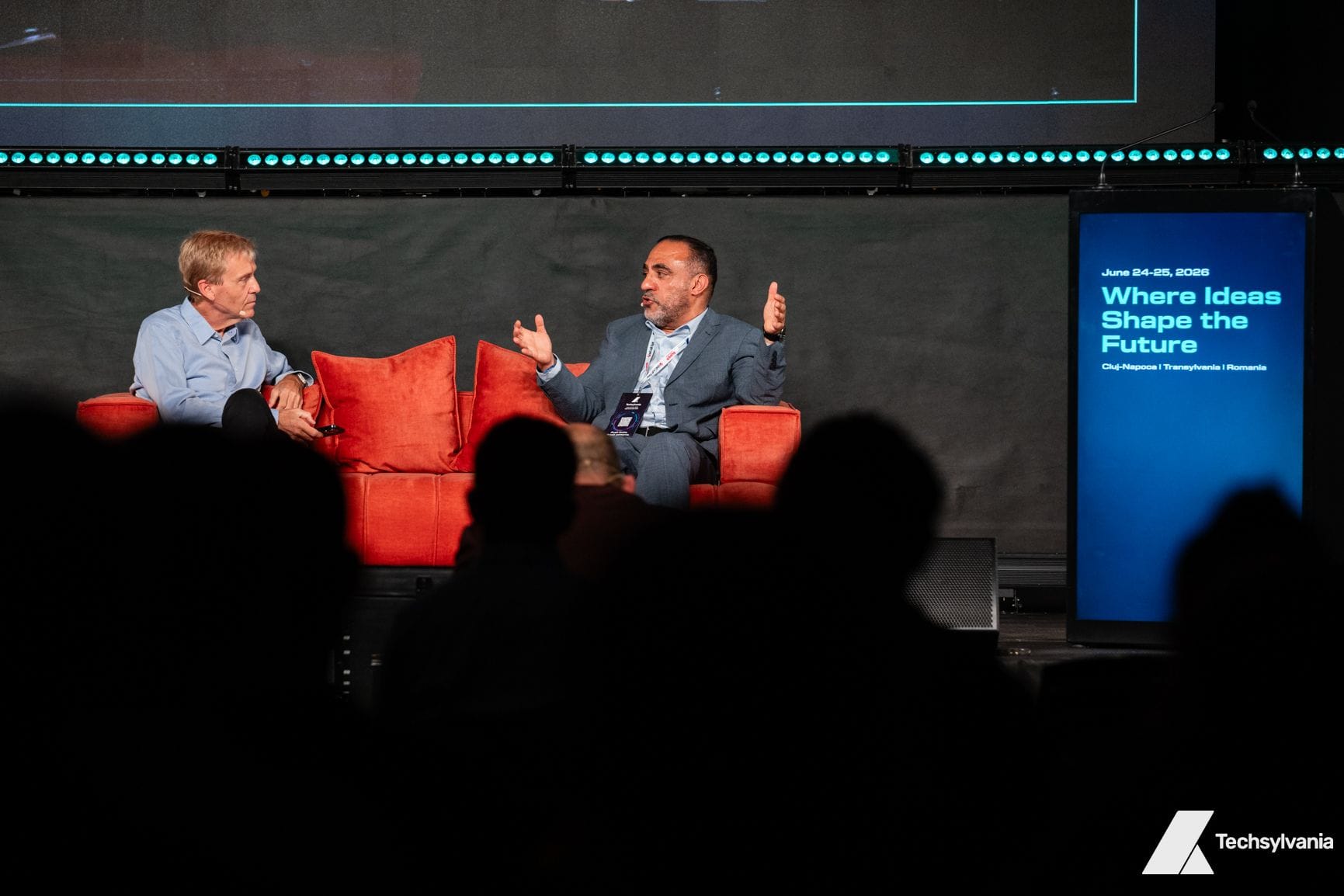
Al Mahmoudi sat down with The Recursive co-founder and Managing Partner Etien Yovchev for an exclusive interview, just after a fireside conversation the SPARK CEO had finished with Mark Porter, former CTO of MongoDB and dbt Labs.
Where is Sharjah's R&D ecosystem in 2026?
Sharjah's R&D ecosystem is well established. We have the right ingredients, the infrastructure, the programmes for technology commercialisation, the policies for intellectual property, and the incentives to attract companies and researchers. We have the right investment climate. The UAE as a whole has put enormous resources into technology and innovation, and Sharjah leverages that national drive and strategy.
The way I describe the park is three layers. The base layer is the free zone. One layer up, we are a technology park — that is where the laboratories, the acceleration programmes and the technology-transfer activity sit, and where we work with universities, research centres and startups from all over the world. The top layer is an R&D centre — a launching pad for companies that want to scale and enter the market, with access to labs, infrastructure, investment and projects.
And we did not build it in isolation. Before we started, we benchmarked the park against around 20 cities worldwide. I often point to Kendall Square in the US where you have MIT and Harvard, and everything grew around them. That is the model we work towards: the university, industry, government and the startups all connected, physically and structurally. That is where we are, and where we keep building.
And from your perspective, what's the current state of the tech ecosystems across Central and Eastern Europe?
It's flourishing. There is real momentum behind startups, AI, mobility, communications, environmental tech, and a lot of eagerness from young talent to start their own companies. That is healthy. But those startups need support, guidance and mentorship. They need to scale, and they need access to investment.
And they need partnerships. That is the keyword. These hubs and centres have to build partnerships rooted in the local mission, growing the local economy, but with a global vision. We live in a small, connected world. You can develop something in Cluj, raise the investment from the UAE, and do part of the development in Bulgaria. You have to be creative about it. But partnership is everything.
What's your strategy for building partnerships in Europe?
We have an umbrella strategy for Europe. We work very closely with the EU, we are part of the European Enterprise Network as an organisation, which gives us access to European programmes, events and collaborations. Under that umbrella, we focus on specific sectors: healthcare, mobility, environmental tech, and advanced manufacturing. And we execute through ground-level programmes with startup communities, universities, research institutes and other ecosystem players.
Give me a practical example. If a research institute or university here in the region wanted to partner with SPARK, what would that look like in practice?
Take mobility, I saw a solar car competition here, and we have a focus on automotive innovation too. The partnership could take several forms. It could be a knowledge exchange. It could be promotion, demos and pilots, actually testing the technology.
A lot of European countries do not have enough sun, so if you have built something solar, you need to test it in the heat. We can be the platform where you verify it.
It could be about investment; some of these technologies need capital, and we can help facilitate that. Or it could be about market access; some companies see our region as their growth market and want to open up there, and we provide that landing platform. The form depends on the opportunity. But the infrastructure in the UAE makes a good landing pad for these companies and collaborations.
What should European companies, investors and institutions keep in mind when expanding to the UAE and Sharjah? Are there frequent mistakes you'd warn people about?
They have to be patient. Like anywhere, starting a business is not easy. Do your homework on choosing the right location, and do not just follow the hype. Find the right partners. And be realistic: this is a venture that takes time and work.
The thing it cannot be is remote. A lot of people think, I'll take a trip, pick up some business, and that business will generate money while I'm back home. That is the perfect formula if it works but it almost never does.
If you are serious, you have to have skin in the game. You have to be on the ground. As we were saying earlier, it is all about people and communication. The more you connect, the better people know you, and the more they trust you. If you are there, the opportunities are in front of you - morning, afternoon, late at night.
Online can help, but it cannot do the job. So find a way to have a presence. Ours is one of the few regions in the world right now with access to funding and a genuinely progressive, long-term government vision. I would encourage people to look at it seriously.
I want to ask about commercialising scientific research. What's your experience in Sharjah, and how do you cultivate the environment where this is possible?
It is the same challenge everywhere. University professors are often sceptical of the private sector. They are passionate about their work and believe they know it best, while industry is focused on making money.
So you need people in the middle who understand both sides and can bring them closer. That is part of what the park does. What we have done is develop our own intellectual property framework and our own commercialisation framework because every country has its own cultural and business characteristics.
You cannot just import a model from the US or China and paste it on top. People reference Silicon Valley, but it has its own background. You have to build your own, with a vision that is still global enough to work with Bulgarians, Romanians, Americans, Chinese, and Indians.
And honestly, we like to imagine these things happen bottom-up. In my experience, they only work top-down. Someone has to take the leadership, and I think that is a role for government. We have built a framework that includes academia's vision, the private sector and NGOs, with a mission to serve the local context but a global outlook. It is not easy. But if there is one thing the UAE does well, it is this - we have more than 230 nationalities living there. It is embedded in our DNA. We are comfortable wherever we go, because we already know how people think.
For any innovation ecosystem to succeed, you need talent from all over the world, and the UAE has been good at attracting it. From your perspective, what's actually doing the attracting?
Vision. What you demonstrate to people is that even in difficult times, this is a country that is well-managed, has a vision, and executes it consistently and professionally.
Leadership matters enormously, because it builds trust, and it is all about trust. People have watched this country through war in the region, through the pandemic, and it never shook.
During COVID, we handled it about as well as any country in the world. Nothing closed. Everyone got their vaccines. We even sent vaccines abroad. People want to secure their future and trust the system, and that is what vision gives them. But execution and consistency matter just as much.
You do not do one thing this year, decide after two years it did not work, and jump to something else - that confuses people. It is like building a business. If you believe in it, you stay on track. We keep reviewing, upgrading and fixing. It is not a perfect place. We make plenty of mistakes but our mentality is disciplined.
What should the role of media be in developing an innovation ecosystem?
Media plays a big role, especially now. Technology companies want fair, balanced media and smart people who actually understand the technology.
One of the challenges with deep tech is that not everyone understands it. If you talk to most people about nanotechnology or 3D printing or AI, they do not follow. If the media is equipped and professional enough to make those things easier to understand, it does a real service.
Having smart companies in a society or a government that does not understand them gets you nowhere. That is often why companies go elsewhere: they hit a wall, and the wall is usually about communication.
Say I am a government official, and you come to me with cutting-edge 3D-printing technology and want to construct a building with it. If I do not understand it, I will say no, it is too risky. If I am informed, I will say, sit down, explain it to me.
That is the role of media in this context: to educate society about technology.
Earlier, on stage with Mark Porter, Al Mahmoudi was asked why the Gulf, the US and China are racing ahead on AI while Europe lags, his answer was a single word, repeated - speed. He told the story of Emirates placing a historic aircraft order the same day the aviation industry collapsed after 9/11. A year later, he said, planemakers were chasing Emirates. The lesson he draws: invest today, because tomorrow is more expensive. Europe is changing, he thinks, but slowly.
The corridor he wants to build with Central and Eastern Europe is framed as the opposite of a race. SPARK runs projects with American, Chinese and European partners, he pointed to Stargate UAE, the data-centre initiative he described as a collaboration between OpenAI, Nvidia, Microsoft and the US government.
"It's not a zero-sum game," he said. "We're a tiny country. We have to work with everyone." For Cluj, and the region more broadly, it’s similar: pick a focus - automotive, space, healthcare, and SPARK mobilises around it, university to university, company to company, government to government.
Whether the corridor materialises this time is an open question. But his read on the region was unambiguous. "It's all about people," he said. "And I think we have the right people here."


Member discussion