


Artificial intelligence has accumulated enough mythology to become its own management problem.
Somewhere between the declarations of one-person billion-dollar companies and the endless stream of AI-generated thought leadership, a practical question has become surprisingly difficult to answer:
What should companies actually do with AI?
For Igor Bogicevic, CEO and co-founder of Deyta.ai, the answer starts with human judgment. For Ioana Alexandra Frincu, CTO at Eazy Asigurări, it starts with an overloaded inbox.
Together, they offered something more useful than another AI prediction: start small, solve real problems, and don’t confuse automation with autonomy.
Automation is not the goal? Liberation is.
Bogicevic opened with a reminder that felt almost unfashionable in today’s AI climate: automation is not the goal. Liberation is.
The point is not to prove that software can imitate people. The point is to remove repetitive work so people spend more time where decisions actually matter.
“How can we actually liberate ourselves to do more strategic work, more work that actually has a high value?” Bogicevic asked.
“That’s always been the name of the game since the industrial revolution. Your value is not in writing more emails. It might be closing more customers, it might be handling the board… how to free yourself to have more time to really do the high-value work?”
That framing quietly changes how AI projects get selected.
Instead of starting with the technology (Which model? Which agent? Which platform?) start with friction.
50 times cheaper: How a CTO automates insurance
At the AI workshop at Hellen’s Rock Retreat, Ioana Alexandra Frincu, demonstrated how her team built an AI-powered email triage system for about €1,000 a year, ditching enterprise tools that cost 50 times more and saving employees hours of manual work every day.
The company receives roughly 5,000 incoming emails per month through a shared inbox. Those messages include sales inquiries, but also insurance claims — and claims come with legal deadlines.
“We have a legal requirement to respond to claim notifications in a certain number of days. If we don't do that, we can get legal repercussions,” Frincu explained.
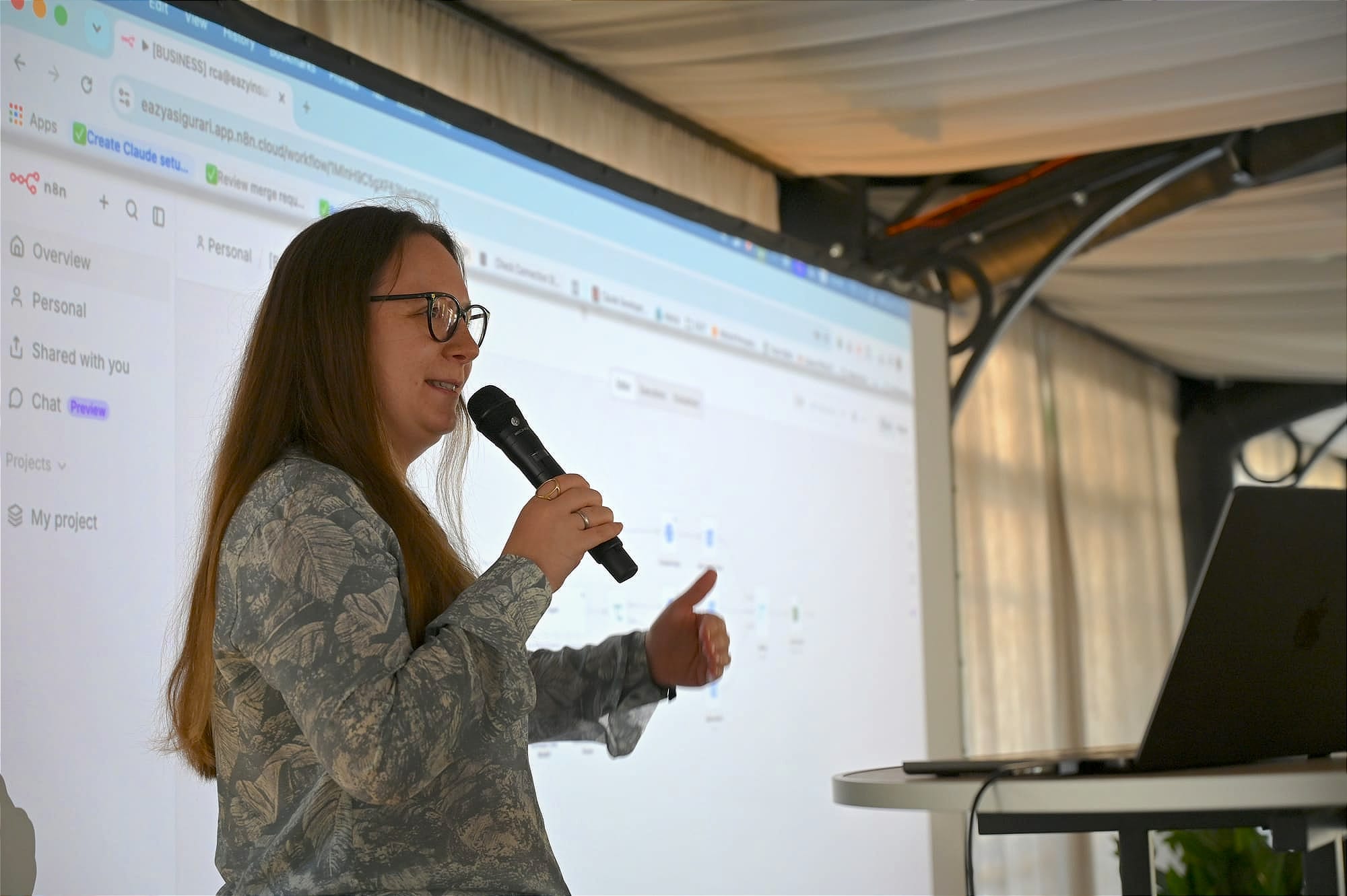
Initially, a person manually reviewed and redirected incoming emails. It worked until it didn’t. As volume increased, messages started getting delayed or missed. The issue wasn’t productivity anymore, it became risk. Instead of buying a large enterprise automation stack, Frincu’s team built a lightweight workflow using open-source tooling.
The system monitors Outlook, checks incoming emails, interprets content through AI models, and routes messages to the right team. The first version wasn’t particularly sophisticated. No memory. No autonomous agents. No complex orchestration. Just classification and routing.
“It's not very smart, but smart enough to do the job,” Frincu said.
And that turned out to be enough. According to her, comparable enterprise solutions can cost upwards of $50,000 annually.
“This is what enterprise providers sell you for $50,000 a year and upwards. And if you build it on your own in n8n, it costs about a thousand a year. So it's 50 times cheaper.”
The second version of the workflow introduced something more difficult.
Insurance claims are not one-off events. Once a claim is opened, every future interaction needs to reach the same handler. Now the system had to remember the state. By connecting email routing to a regularly refreshed internal dataset, the workflow started assigning follow-up communication automatically. The reported result: hours recovered every day. The automation saved the team three hours a day and the implementation time was two days, including the testing.
The one thing we have as humans? Taste and judgment
While advocating for automation, Bogicevic delivers a strong dose of realism, warning against the sensationalist narratives often found on social media. He stresses that as more tasks become automated, our core value shifts to oversight, critical thinking, and discernment. The ability to evaluate the output of an AI, to question its conclusions, and to apply context-specific wisdom is a skill that cannot be outsourced to a machine.
Bogicevic pointed to a broader concern raised across the industry: that blindly outsourcing decision-making can make teams faster, but also more average. AI can help generate possibilities; judgment still determines which ones matter.
“You should keep your mind open. And you should use your judgment as a human. That’s the best thing that we have: taste and judgment… because so many other things can be automated right now.”
Just have fun… this whole thing is a big experiment
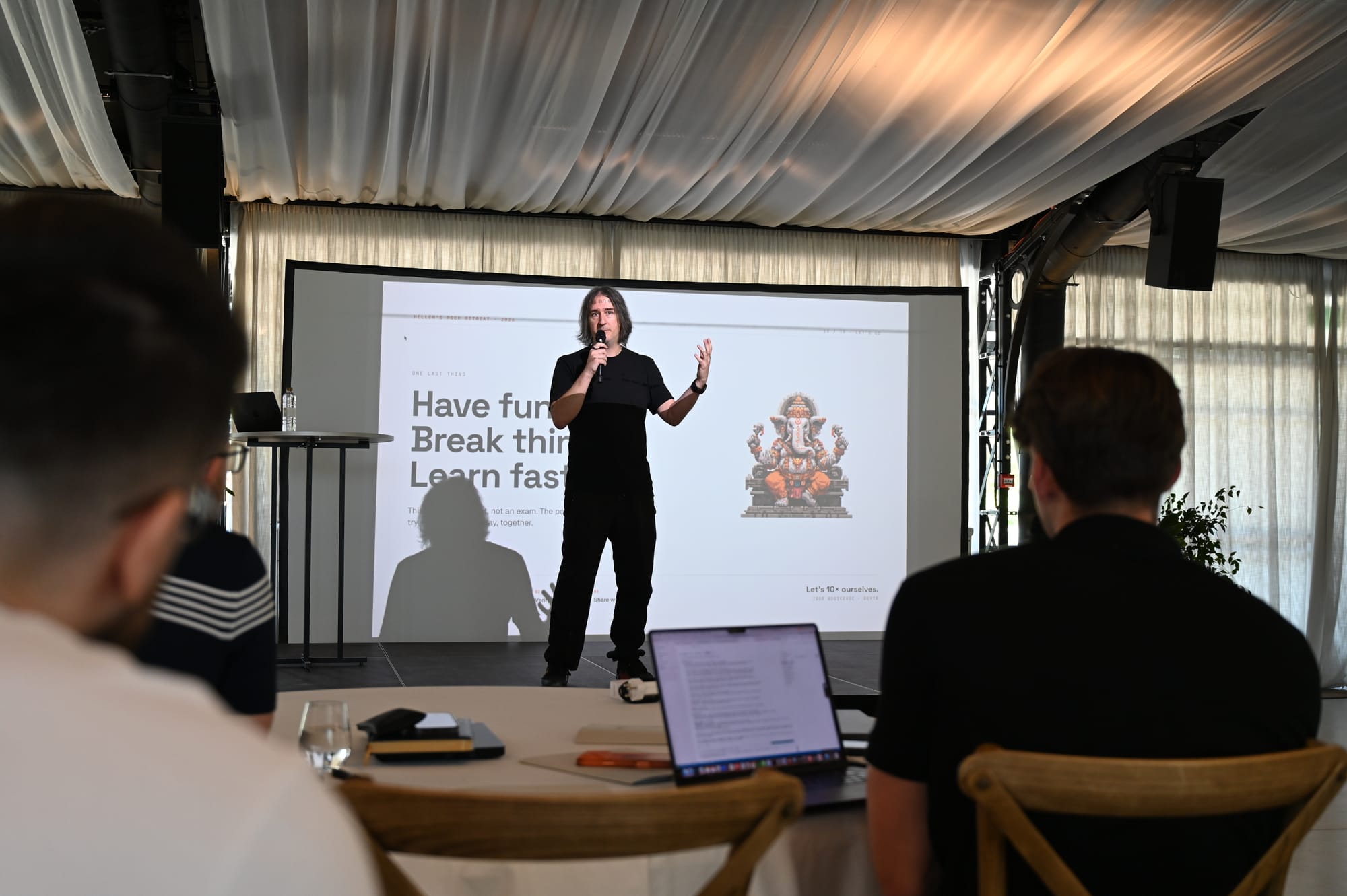
The AI landscape is moving at a breakneck pace, but Bogicevic shares that we are still at the very beginning of this new technological chapter. This uncertainty, he suggests, should be seen not as a risk, but as an invitation to participate.
“Just have fun. I mean, this is a whole big experiment in some sense,” he advises.
“It feels like it’s been 20 years since this all started, everything is moving so fast. But if you just look, the frontier is still open. It’s so many things are undefined.”
His final piece of advice is a practical call to action: rather than waiting for the perfect, all-encompassing AI solution, the time to start is now, with the real-world problems we face every day.
“Pick something that’s your real problem. Try to automate it. And, you know, let’s see how it goes.”


Member discussion